
Types of Freelance Contracts in 2025: The Ultimate Guide to Protecting Your Income
In the high-stakes world of 2025 freelancing, your skill gets you hired, but your contract gets you paid.
Many freelancers treat contracts as a formality—a boring PDF they sign just to get started. This is a fatal mistake. In an economy defined by AI automation, global inflation, and remote work jurisdiction issues, your contract is your only line of defense.
Choosing the right types of freelance contracts isn’t just about legal safety; it is about financial strategy. The difference between a “Retainer Agreement” and a “Fixed-Price Contract” can mean the difference between feast-or-famine stress and a stable, six-figure income.
Whether you are a creative, a developer, or a consultant, understanding the different types of freelance contracts available to you is the single highest-ROI skill you can learn this year.
This guide will walk you through every major contract model, the specific clauses you need to survive 2025 (including the new “AI Usage” rules), and how to choose the right structure for your business.
Part 1: The “Big Three” Types of Freelance Contracts
Most client relationships fall into one of these three buckets. Knowing which one to pitch is your superpower.
When evaluating the different types of freelance contracts, you must first look at the nature of the work. Is it a one-time sprint, or a marathon?
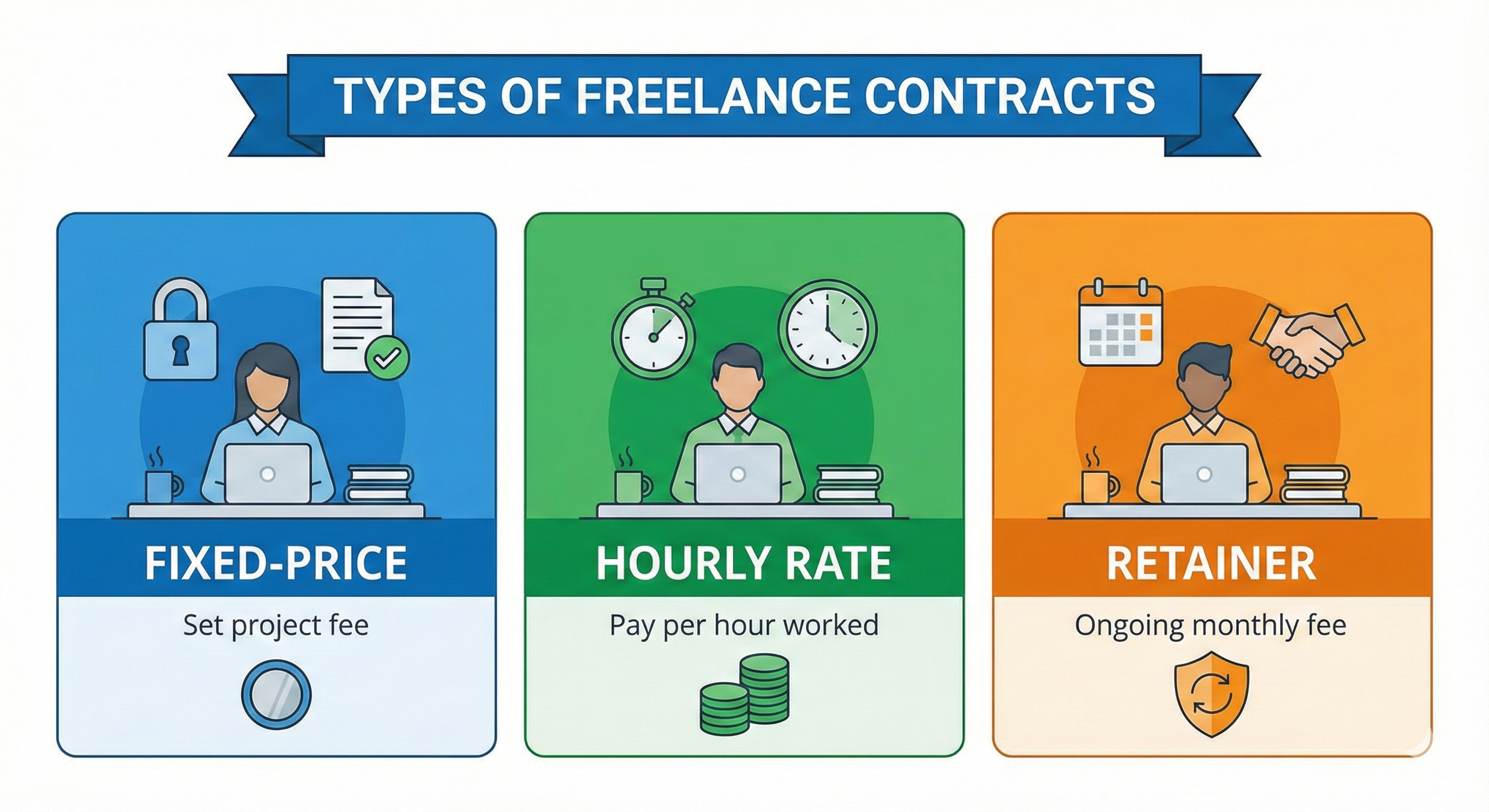
1. The Project-Based (Fixed-Price) Contract
Best for: Distinct deliverables with a clear beginning and end.
Among all types of freelance contracts, this is the most common for beginners. You agree on a single price for a single outcome (e.g., “Build a Website for $5,000”).
- The Pro: It rewards efficiency. If you quote 20 hours but finish in 5 using AI tools, you keep the profit.
- The Con: “Scope Creep.” Clients love to add “just one small change” for free.
- 2025 Strategy: Never sign these types of freelance contracts without a strict “Scope of Work” (SOW) clause that defines exactly what is not included.
2. The Hourly Rate Contract
Best for: Vague projects, maintenance, or “exploratory” work.
Hourly agreements are the safest of the types of freelance contracts when the scope is undefined. If a client says, “We need you to help us figure out our marketing strategy,” you should bill hourly.
- The Pro: You get paid for every minute, including meetings and phone calls.
- The Con: It punishes efficiency. As you get faster, you earn less.
- 2025 Strategy: Use this for “Phase 1” of a relationship, then transition to a fixed or retainer model once the scope is clear.
3. The Retainer Agreement (The Holy Grail)
Best for: Stability, cash flow, and long-term relationships.
Of all the types of freelance contracts, the Retainer is the gold standard. The client pays a fixed monthly fee (e.g., $2,000/month) for a set amount of work or availability.
- Types of Retainers:
- Pay-for-Work: “I will write 4 blogs per month for $2,000.”
- Pay-for-Access: “I am available for advice and strategy calls for $2,000/month.” (This is the consultant’s dream).
- Why it wins: It breaks the “feast or famine” cycle. You start every month knowing your rent is paid.
Part 2: Advanced Types of Freelance Contracts for 2025
Beyond the basics. These models are for freelancers ready to scale.
As you evolve, the standard types of freelance contracts might restrict your growth. Here are advanced models used by top-tier experts.
4. The “Time and Materials” Contract
This is a hybrid often used by developers and agencies. It combines the safety of hourly billing with the predictability of a project fee.
- How it works: You bill for your time (hourly) plus the cost of any materials (software licenses, stock photos, API costs).
- Why use it: It protects you from inflation. If the price of a software subscription doubles during the project, the client pays for it, not you.
5. The Performance-Based Contract
For marketers and sales pros, these types of freelance contracts offer the highest ceiling.
- The Deal: “I will write your sales emails for free, but I get 10% of every sale they generate.”
- The Risk: If the product sucks, you earn $0.
- The Reward: If the product flies, you can earn $50k from a weekend of work.
Part 3: 2025-Specific Clauses (The “Secret Sauce”)
Standard templates are dangerous. You need these modern clauses.
Most free templates online are from 2018. They don’t cover AI, inflation, or global remote work. No matter which of the types of freelance contracts you choose, you must insert these specific clauses to be safe in 2025.
1. The “Generative AI Usage” Clause
Clients are now terrified of copyright lawsuits. They need to know if you used ChatGPT to do the work.
- The Clause: Define exactly how you use AI.
- Option A (Transparent): “The Freelancer may use AI tools for outlining and research, but all final deliverables will be human-edited and verified.”
- Option B (Ownership): “The Client owns the final output, but acknowledges that AI-generated components may not be copyrightable under current US law.”
- Why it matters: Ignoring AI in your types of freelance contracts can lead to lawsuits if a client discovers you used automation without disclosure.
2. The “Inflation Adjustment” Clause
With global inflation fluctuating, a long-term retainer can lose value quickly.
- The Clause: “For agreements lasting longer than 12 months, the monthly fee shall automatically increase by 3% (or match the CPI) to account for inflation.”
- Why it matters: It ensures your income doesn’t technically shrink over time.
3. The “Kill Fee” (Cancellation Clause)
What happens if a client cancels a project halfway through?
- The Clause: “If the Client cancels the project after work has commenced, a ‘Kill Fee’ of 50% of the remaining balance is immediately due.”
- Why it matters: It prevents you from booking out your schedule for a client who ghosts you.
Part 4: Critical LSI Clauses to Include
To make your contract bulletproof, ensure these legal terms are present in all types of freelance contracts.
- Scope of Work (SOW): Be painfully specific. Don’t write “Web Design.” Write “5-page WordPress site using Elementor, excluding copywriting.”
- Intellectual Property (IP) Rights: Who owns the work? usually, rights transfer only upon full payment. This is your leverage.
- Payment Terms: Net-15 or Net-30? Late payment penalties (e.g., “5% interest per month on overdue invoices”) are mandatory to ensure cash flow.
- Indemnification: This protects you if your work accidentally gets the client sued (e.g., they get sued for a stock photo you chose).
- Force Majeure: What happens if the internet goes down or a war starts? This clause pauses the contract during disasters.
Part 5: How to Choose the Right Contract for Your Niche
Not all types of freelance contracts fit every industry.
For Writers & Creatives
- Best Choice: Project-Based or Retainer.
- Avoid: Hourly. (You type fast; why be punished for it?)
- Critical Clause: Revisions. Limit them to “2 rounds of edits.” Otherwise, you will be editing forever.
For Developers & IT
- Best Choice: Hourly or Time and Materials.
- Avoid: Fixed Price (unless the spec is perfect). Code always breaks, and scope always creeps.
- Critical Clause: Bug Fix Period. “Bugs found within 30 days are fixed for free; afterwards, they are billable.”
For Consultants & Coaches
- Best Choice: Retainer (Pay-for-Access).
- Avoid: Deliverable-based contracts. You are selling your brain, not your hands.
- Critical Clause: Availability. Define your response times so clients don’t call you at 3 AM.
Part 6: Common Pitfalls When Drafting Contracts
Mistakes that cost freelancers millions.
Even if you pick the right one of the types of freelance contracts, a bad setup can ruin it.
- Starting Work Without a Deposit: Never start without skin in the game. A 50% upfront deposit is industry standard for fixed-price projects.
- Vague “Termination” Clauses: How do you break up? Ensure either party can end the contract with 14 or 30 days’ written notice. You don’t want to be trapped with a toxic client.
- Ignoring Jurisdiction: If you are in the UK and the client is in the US, which country’s laws apply? Always specify your home location as the governing law to avoid expensive international lawsuits.
Final Thoughts: Your Contract is Your Business Partner
Ultimately, the different types of freelance contracts are tools in your toolkit. You shouldn’t just use one.
You might have a Retainer for your anchor client, a Project-Based contract for a new lead, and an Hourly agreement for a messy consulting gig.
The goal isn’t to trap the client; it’s to create clarity. A strong contract, clearly written, is the best marketing tool you have. It tells the client: “I am a professional. I take this seriously. You are in safe hands.”
Your Next Step: Audit your current agreements. Do they have the 2025 “AI Usage” clause? Do they have an “Inflation Adjustment”? If not, it’s time to redraft.
Need more clients to send contracts to? Once your legal templates are ready, you need to fill your pipeline. Read our guide on How to Sell SEO Services.