
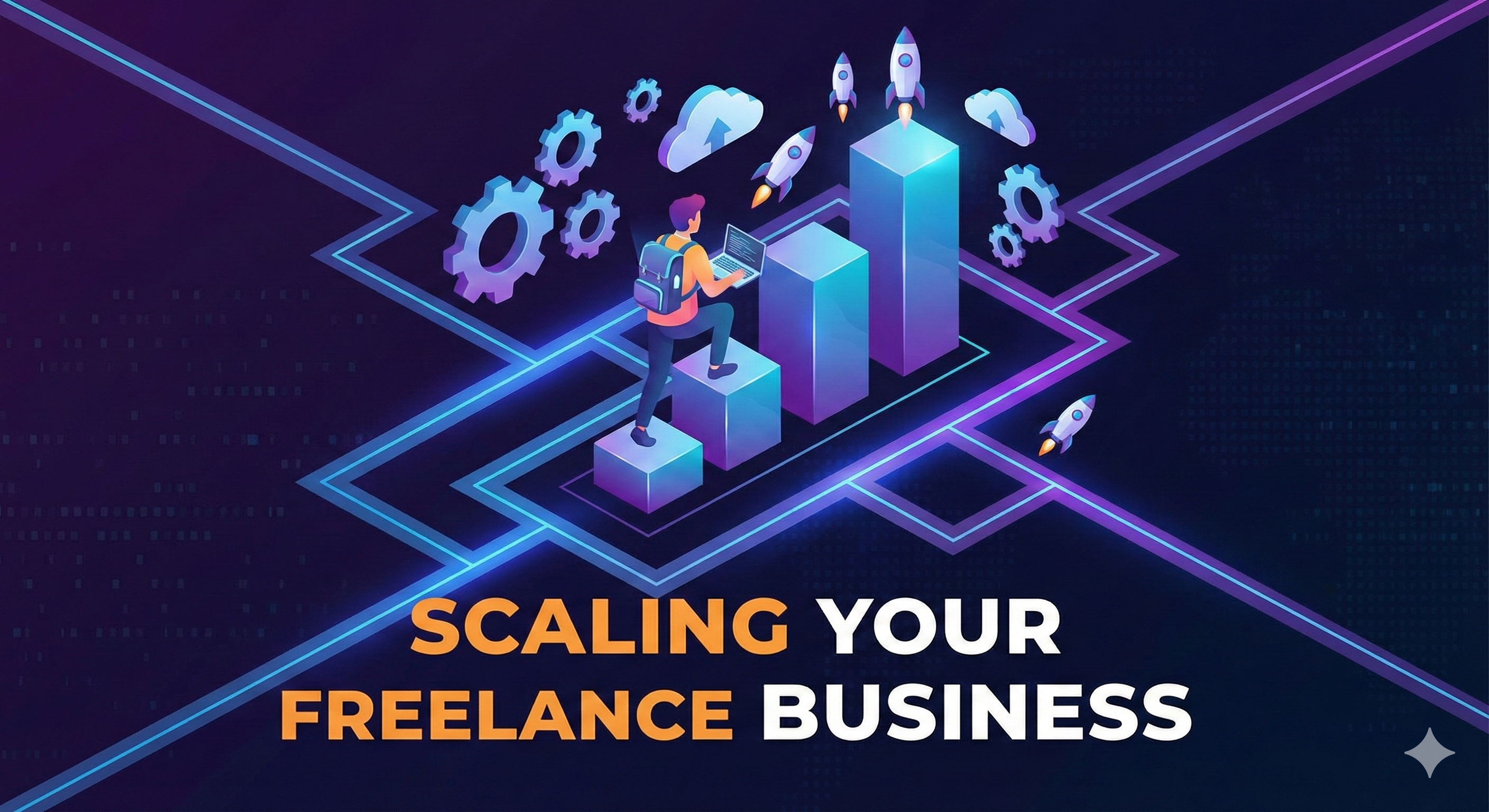
Scaling Freelance Business in 2025: The Ultimate Guide to Agency Growth
In the early stages of freelancing, success feels like just getting fully booked. You trade your time for money, and when the calendar is full, you feel like you’ve made it.
But then, you hit the “Freelancer’s Ceiling.”
You can’t work more hours. You can’t take on more clients. Your income flatlines, and burnout creeps in. This is the moment every successful freelancer faces: the choice between staying small or scaling a business into something bigger than themselves.
In 2025, scaling freelance business operations isn’t just about hiring people. It’s about building systems. It involves shifting from a “service provider” mindset to a “business owner” mindset. It means moving away from hourly billing and toward value-based pricing, automation, and recurring revenue models.
Whether you want to build a boutique agency, launch digital products, or create a “productized service” empire, this guide is your blueprint. We will walk you through the exact strategies for scaling a freelance business from a chaotic solo operation to a streamlined, high-profit machine.
Part 1: The Foundation of Scaling (Systems Over Hustle)
You cannot scale chaos. Before you add more clients, you must fix the cracks in your foundation.
Most freelancers try to start scaling a business by pouring more water into a leaky bucket. They spend money on ads or outreach before they have the systems to handle the volume. The result is always the same: missed deadlines, angry clients, and exhaustion.
To succeed in scaling freelance business revenue, you must first document everything.
1. The SOP (Standard Operating Procedure) Revolution
If you are the only one who knows how to do the work, you are the bottleneck. To fix this, you must build a “Company Wiki.”
- Document the Routine: Record a Loom video of yourself doing every repetitive task (invoicing, onboarding, keyword research).
- Write the Checklist: Turn that video into a step-by-step checklist in Notion or ClickUp.
- The Goal: You should be able to hand this document to a stranger, and they should be able to complete the task 80% as well as you.
2. Automate the “Boring” Stuff
In 2025, if you are manually sending invoices or scheduling meetings, you are wasting time that could be used for scaling a business.
- CRM Automation: Use tools like Dubsado or HoneyBook. When a client signs a contract, the system should automatically send the invoice, the welcome packet, and the Slack invite.
- Project Management: Use Zapier or Make.com to connect your apps. When a new task is added in Asana, it should automatically alert you in Slack.
By removing yourself from the admin work, you clear the mental space required for scaling freelance business strategy.
Part 2: The “Productized Service” Model (The Secret Weapon)
Stop selling custom solutions. Start selling products.
The hardest part of scaling a freelance business is “Scope Creep.” Every client wants something different, which means you have to write custom proposals and invent new workflows every time.
The solution is the Productized Service.
What is a Productized Service?
Instead of saying “I do graphic design,” you say: “I sell a monthly design subscription for $2,000/month. You get unlimited requests, one at a time.”
This is the essence of scaling a subscription business. You turn a service (which is variable) into a product (which is fixed).
Why This Scales
- No Proposals: The price is on the website. Clients click “Buy Now.”
- Predictable Scope: You define exactly what is included (e.g., “Blog posts up to 1,000 words”). If they want more, they upgrade.
- Recurring Revenue: This is the holy grail of scaling a business. You don’t start the month at $0. You start with your MRR (Monthly Recurring Revenue) already in the bank.
If you look at the most successful creative agencies in 2025, many of them are actually scaling a subscription business model disguised as an agency.
Read our guide on How to Sell SEO Services for a more detailed guide
Part 3: Pricing Strategy for Growth
You cannot scale on “cheap.”
A common mistake when scaling freelance business income is keeping “Legacy Clients” who pay 2020 rates.
To grow, you must raise your floor.
The “Velvet Rope” Strategy
As demand grows, your prices must increase. This naturally filters out high-maintenance, low-budget clients.
- The Audit: Look at your client list. Who pays the least but emails the most? Fire them.
- The Replacement: Replace that time with high-ticket clients who respect your boundaries. Scaling a business is often about doing less work for more money.
Moving to Value-Based Pricing
Stop charging by the hour. Hourly billing punishes efficiency.
- Hourly: You work faster, you get paid less.
- Value: You charge $5,000 for a landing page because it will generate $50,000 in sales for the client. It doesn’t matter if it takes you 3 hours or 3 weeks.
Read more on How to Negotiate Freelance Rates to get good at this.
Part 4: Building Your Team (The Agency Transition)
From “I” to “We.”
Eventually, scaling freelance business capabilities means hiring help. But you don’t need to hire full-time employees immediately.
1. The “Drop-Service” Model (White Labeling)
This is the lowest-risk way of scaling a business. You act as the project manager and “face” of the brand, but you hire other freelancers to do the execution.
- Scenario: You sell an SEO package for $2,000. You hire a writer for $300 and a technical SEO expert for $500. You keep $1,200 for managing the strategy and client relationship.
2. Hiring “Specialists,” Not “Generalists”
Don’t hire a “Marketing Assistant” to do everything. Hire a “Pinterest Expert” for Pinterest and a “Copywriter” for emails.
- Why: Specialists deliver better results faster. When scaling a subscription business, quality speed is everything.
3. The “fractional” COO
When you reach ~$10k-$15k/month, you will drown in operations. Hire a “Fractional Project Manager” or “Online Business Manager” (OBM) for 5-10 hours a week. They handle the team so you can handle the vision.
Part 5: The “Subscription” Pivot
How to turn one-off projects into lifetime value.
We touched on this earlier, but it deserves a deep dive. Scaling a subscription business is the ultimate stability hack for freelancers.
Ideas for Subscription Models:
- Writers: “4 Blog Posts Per Month” package.
- Developers: “Website Maintenance & Security” retainer.
- Designers: “Unlimited Thumbnail Creation” for YouTubers.
- Consultants: “Async Voice Note Access” (Voxer coaching) for a monthly fee.
The Metrics That Matter
When you are scaling a subscription business, you stop looking at “Project Fees” and start looking at:
- Churn: How many clients cancel each month? (Keep this under 5%).
- LTV (Lifetime Value): How much does the average client pay you before they leave?
- MRR: Monthly Recurring Revenue.
Focusing on these metrics allows you to predict cash flow and invest confidently in ads or hiring, which fuels further scaling freelance business growth.
Part 6: Marketing & Lead Generation at Scale
Stop chasing. Start attracting.
You cannot rely on referrals alone when scaling a business. Referrals are inconsistent. You need a “Lead Engine.”
1. Content Marketing (Inbound)
Become the “go-to” expert. Write articles about the problems your clients face.
- Example: If you are an SEO expert, write “How to Fix Traffic Drops in 2025.”
- Goal: When they search for a solution, they find you.
2. Paid Acquisition (Outbound)
Once you have a high LTV (thanks to scaling a subscription business model), you can afford to pay for leads.
- Running LinkedIn Ads or Google Ads to your “Productized Service” landing page becomes a math equation: Spend $1 to make $3.
3. Strategic Partnerships
Find non-competitors who serve the same audience.
- If you are a Copywriter: Partner with Web Designers. When they build a site, they recommend you for the text.
- If you are a Developer: Partner with SEO agencies.
- Result: A steady stream of warm leads without cold calling.
Part 7: Managing the Mental Game
The hardest part of scaling is you.
Scaling a business breaks things—including your confidence. You will face “Imposter Syndrome” as you raise rates. You will feel guilty when you delegate work you used to do yourself.
The “CEO” Identity Shift
To succeed in scaling freelance business operations, you must fire yourself from the daily tasks.
- The Trap: “It’s faster if I just do it myself.”
- The Truth: If you do it yourself, you are saving $50 but costing the business $5,000 in lost growth.
Your job is no longer to “do the work.” Your job is to “design the machine that does the work.”
Final Thoughts: The Roadmap to Freedom
Scaling a freelance business is not about working 80 hours a week. It is about building a system that allows you to work less while earning more.
By implementing SOPs, moving to a scaling a subscription business model, and hiring specialists, you detach your income from your time.
Your Checklist to Start Scaling Today:
- Audit: Identify the one task taking up 80% of your time. Document it.
- Package: Create one “Productized Service” offer with a fixed monthly price.
- Hire: Find one freelancer to take the “boring work” off your plate using the Drop-Service model.
The transition from “Freelancer” to “Founder” is challenging, but on the other side lies true financial freedom.