
How to Build a Freelance Portfolio with No Experience (The “Zero-to-One” Guide)
The “Freelancer’s Paradox” is the most frustrating part of starting out: You need a portfolio to get clients, but you need clients to build a portfolio.
Most beginners get stuck here. They wait for someone to “give them a chance.” But in 2025, high-paid freelancers don’t wait for permission, they create their own opportunities.
If you have zero clients, you actually have a massive advantage: Complete Creative Control. You don’t have a boss telling you to change the font size or water down your copy. This guide will show you how to build a “Mock Portfolio” that looks so professional, clients won’t believe you are a beginner.
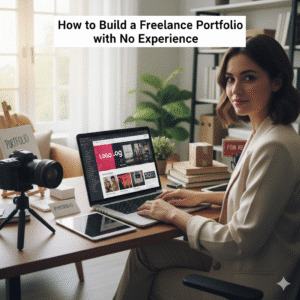
Step 1: The “Spec Work” Strategy
Stop waiting for clients. Invent them.
“Spec work” (speculative work) is work you do for free, on your own terms, to demonstrate your skill. But don’t just design a random logo. You need to solve a real-world problem.
The “Fix-It” Method
Look at local businesses or popular brands that have obvious flaws.
- If you are a Writer: Find a website with a boring “About Us” page. Rewrite it to be punchy and persuasive. Put the “Before” and “After” side-by-side.
- If you are a Designer: Find a local restaurant with a messy menu. Redesign it in Canva or Figma to be clean and appetizing.
- If you are a Developer: Find a slow-loading local website. Build a clone of the homepage that loads instantly and explain how you optimized the code.
Pro Tip: Label these clearly as “Concept Projects.” Clients respect the initiative. It shows you can spot problems and fix them without being asked.
Step 2: Structure Your Case Studies (The STAR Method)
Images are not enough. You need a story.
A portfolio is not just a gallery of pretty pictures. It is a sales pitch. For every project you upload (even the fake ones), use the STAR Method to explain your process:
- S – Situation: “The local coffee shop had a menu that was confusing to read.”
- T – Task: “I needed to redesign it to improve readability and highlight high-margin items.”
- A – Action: “I used brand colors, simplified the typography, and added visual hierarchy.”
- R – Result: “The new design reduces decision fatigue and looks 100% more professional.”
Why this works: Clients hire you for your brain, not just your hands. This structure proves you think like a strategist.
Step 3: The “Beta Client” Launch
Get testimonials before you get paid.
Social proof (testimonials) matters more than your actual work. If a stranger says you are good, other clients believe it.
To get your first 3 testimonials without experience, run a “Beta Test.”
The Script:
“I am launching a new freelance business. I am looking for 3 business owners to beta test my service. I will [write one blog post / design one social banner] for free. In exchange, all I ask is a brutally honest review on LinkedIn if you like the work.”
This is not “working for free”; it is “bartering for reputation.” Three solid LinkedIn recommendations can launch a career.
Step 4: Choose Your Platform (Keep It Simple)
You do not need a $2,000 website.
In 2025, clients want speed. They don’t want to click through complex menus. Here are the best tools to host your portfolio for free:
- For Writers: Medium or Clippings.me. These platforms are optimized for reading.
- For Designers: Behance or Dribbble. These have built-in communities where recruiters look for talent.
- For Generalists: Notion or Carrd. These allow you to build a clean, one-page website in under an hour.
Step 5: Focus on “Transferable Skills”
You have more experience than you think.
Did you organize a charity event in college? That’s “Project Management.”
Did you run the Instagram account for your dog? That’s “Social Media Marketing.”
You don’t need “corporate” experience. You need “relevant” experience. If you are a student, your university assignments can count as portfolio pieces if they are high quality.
Final Checklist: The “Trust” Signals
Before you send your portfolio to a client, ensure it has these three trust signals:
- A High-Quality Photo of You: No anime avatars. Clients want to know who they are paying.
- A Clear “One-Liner”: Don’t say “I do everything.” Say “I help real estate agents write newsletters.”
- Contact Info: Make it impossibly easy to hire you. Put your email or a “Book a Call” link at the top and bottom of the page.
Final Thoughts
Your portfolio is a living document. It doesn’t need to be perfect; it just needs to be published.
The biggest mistake freelancers make is working on their portfolio for months in private. Launch the “MVP” (Minimum Viable Portfolio) today with 3 sample projects. You can always improve it later. The goal is not to win a design award; the goal is to start the conversation.